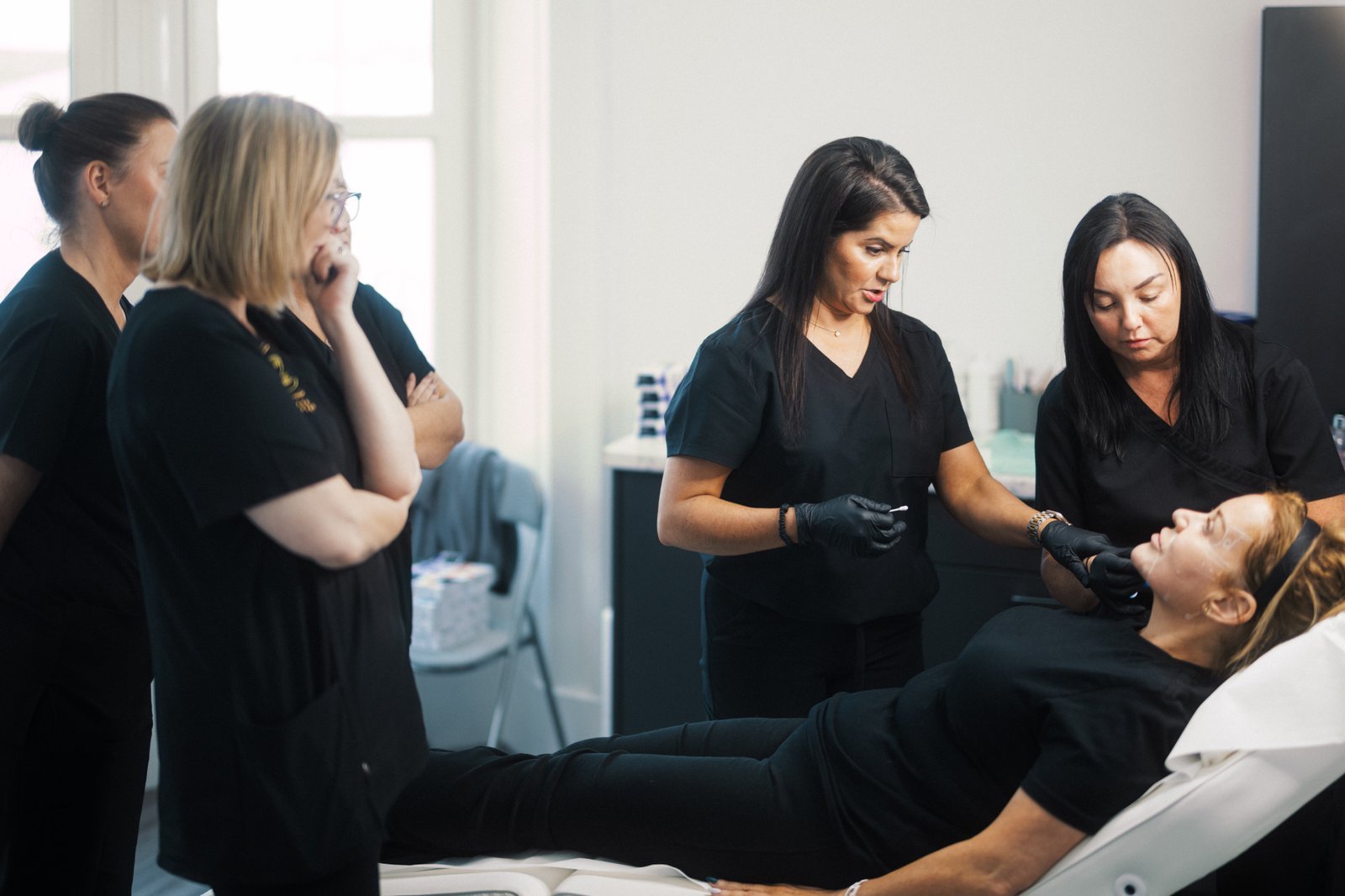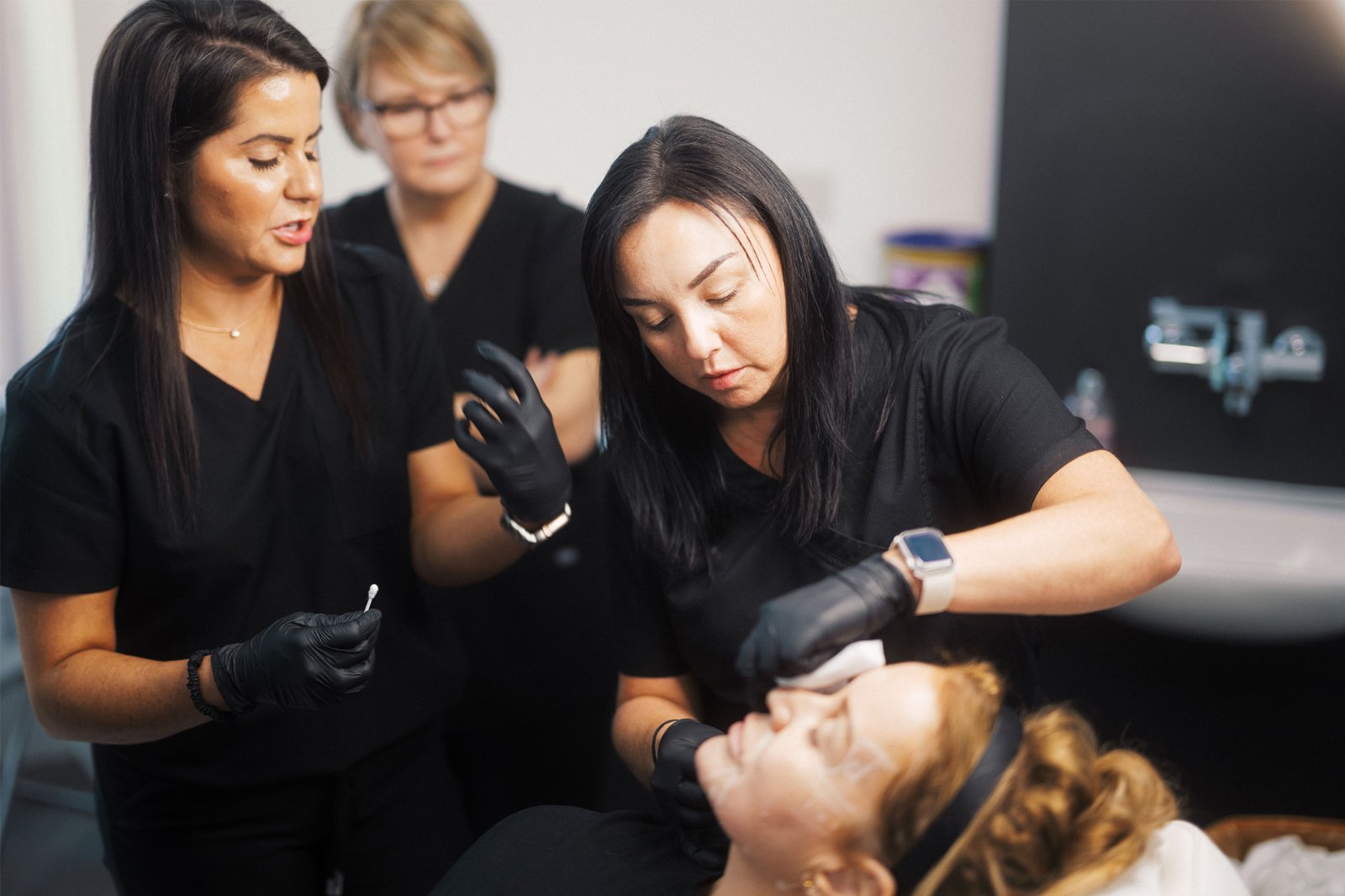

Why Advanced Training Is Often Misunderstood
In the world of aesthetic medicine, the word advanced is used frequently, sometimes too freely. Courses are marketed as advanced after only a short foundation pathway.
Practitioners are encouraged to “level up” by learning new injection sites or trending techniques. But is adding more procedures the same as becoming more advanced?
Not necessarily.
True advanced aesthetics training goes far beyond learning how to perform a new treatment. It is not simply about mastering a cannula technique or attending a masterclass in jawline contouring.
Instead, it is about developing clinical judgement, deep anatomical understanding, and the ability to individualise treatment safely and effectively.
Across the UK (including within medical aesthetics education in Scotland) there is growing recognition that advanced practice is less about complexity of procedure and more about complexity of thinking.
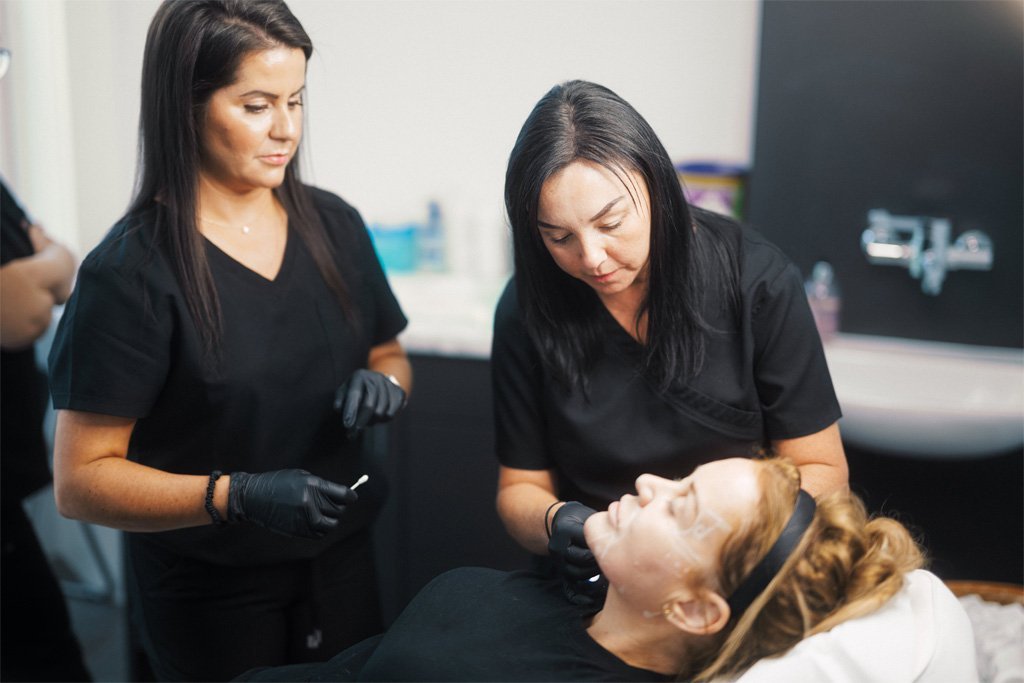
Technique vs Thinking: Why Outcomes Matter More Than Procedures
It is easy to measure technique…
Did the practitioner place the filler correctly?
Was the injection plane accurate?
Was the dose appropriate?
But what truly defines advanced practice is why those decisions were made.
Two clinicians can perform the same technical steps yet achieve very different outcomes. The difference often lies in assessment, planning, restraint, and the ability to adapt in real time.
Advanced clinicians think in terms of:
- Long-term facial harmony rather than isolated feature enhancement
- Structural ageing patterns rather than surface wrinkles
- Risk mitigation rather than aesthetic trends
In other words, advanced practice is outcome-led, not procedure-led.
This distinction is critical in advanced injector training in the UK, where the goal should not be to create technically competent injectors alone, but thoughtful, adaptable practitioners who understand the bigger picture.
The Role of Individualisation
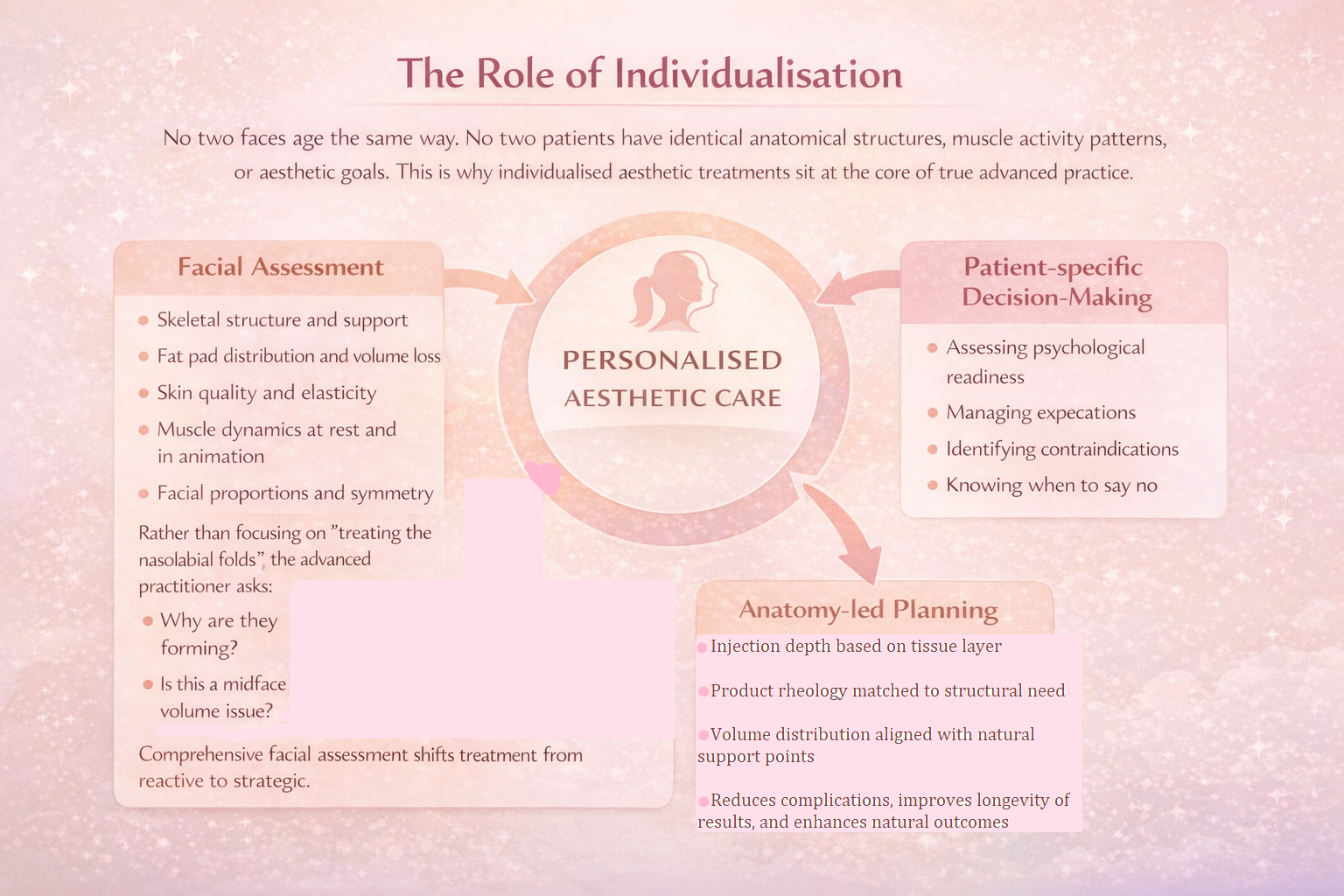
Clinicians who have undergone meaningful advanced aesthetics training understand that overcorrection, overtreatment, and trend-driven interventions can compromise both safety and aesthetics.
Individualisation is about treating the person; not performing the procedure.
Why Protocols Alone Aren’t Enough
Protocols are important. They provide structure, safety guidance, and baseline consistency. But protocols are not substitutes for judgement.
A protocol might state:
- Inject X ml at Y depth using Z product
But what happens when:
- The patient’s anatomy deviates from textbook norms
- There is unexpected resistance during injection
- Vascular compromise is suspected
- The aesthetic outcome appears unbalanced mid-procedure
Advanced clinicians must interpret, adapt, and problem-solve in real time.
This is where many short-format “advanced” courses fall short. They may teach a technique step-by-step, but they do not necessarily develop critical thinking.
Within advanced injector training in the UK, the shift toward complication management, case-based discussion, and live clinical reasoning is essential. Real advancement comes from understanding why decisions are made, not just copying how they are done.
How Advanced Training Changes Clinical Confidence
There is a significant difference between confidence based on repetition and confidence based on competence.
Early in practice, confidence often stems from familiarity. Practitioners feel comfortable because they have repeated a technique many times.
However, advanced confidence looks different. It is quieter, more measured, and grounded in:
- Deep anatomical understanding
- Complication readiness
- Treatment planning clarity
- Ethical restraint
When clinicians undergo meaningful advanced aesthetics training, they become more comfortable in:
- Managing complex cases
- Recognising and treating complications
- Declining inappropriate treatment requests
- Planning multi-stage, long-term strategies
This level of confidence protects both patient and practitioner.
What Clinicians Should Expect From Advanced-Level Education

Advanced education should challenge clinicians to think differently; not just inject differently.
In medical aesthetics education in Scotland, there is increasing emphasis on structured progression pathways rather than one-off masterclasses. This supports sustainable skill development rather than rapid, unsupported escalation into high-risk procedures.
ATA Approach: Teaching Judgement, Not Just Technique
A progressive approach to advanced injector training in the UK prioritises clinical reasoning.
Rather than focusing solely on:
- “How to perform a temple filler”
- “How to create a sharper jawline”
The focus shifts to:
- When should this area be treated?
- When should it not?
- What structural changes are driving the concern?
- How does this intervention affect overall facial harmony?
- What are the risk variables in this specific patient?
Teaching judgement involves slowing down the process.
It involves:
- Detailed pre-treatment analysis
- Discussion of alternative approaches
- Encouraging reflective practice
- Exploring complications openly rather than avoiding them
True advanced aesthetics training develops independent thinkers; not protocol-dependent injectors.
This model aligns with modern expectations in medical aesthetics education in Scotland, where regulatory shifts are placing greater emphasis on safety, governance, and accountability.

Long-Term Competence Over Short-Term Confidence
In aesthetic medicine, rapid confidence can be dangerous.
Short courses may provide a temporary sense of capability, particularly when learning visually impressive procedures. But without deeper understanding, that confidence can outpace competence.
Long-term competence is built through:
- Repetition combined with reflection
- Ongoing anatomical study
- Peer discussion and mentorship
- Complication readiness
- Ethical maturity
Advanced clinicians understand that education does not end after certification. Continuous learning is part of professional responsibility.
For those pursuing advanced aesthetics training, the goal should not be to collect techniques but to refine thinking.
For those enrolling in advanced injector training in the UK, the question should not be “What new area will I learn?” but rather, “How will this improve my assessment, judgement, and safety?”
And for practitioners engaged in aesthetic training for nurses, dentists and doctors, progression should feel like a deepening of understanding; not just an expansion of services offered.
Ultimately, the future of medical aesthetics education in Scotland and the wider UK industry depends on raising standards of reasoning, not just repertoire.
Because truly advanced practice is not defined by how much you inject, but by how thoughtfully, safely, and selectively you choose to treat.
In aesthetic medicine, mastery lies not in technique alone, but in the wisdom that guides it.
Bibliography
- Faces on Faces – 2025 – The Definitive Guide to Advanced Aesthetic Training [online] Available at:
https://www.facesonfaces.com/aesthetics-courses/advanced-aesthetic-training/ - AM Aesthetics – 2025 – Advanced Facial Aesthetics Training [online] Available at:
https://amaestheticslondon.co.uk/advanced-facial-aesthetics-course/